Showing posts with label Classics Club. Show all posts

Sunday, October 7, 2012

Why do I read the classics?

“Reading” – Auguste Renoir (1890-1895)
October's Classics Club Meme is seemingly an easy one: "Why do I read the Classics?"  Appearances can be deceiving and I've spent several days thinking about my answer.  I actually have a few reasons why I read the classics and if I had to put these reasons under a heading it would be "imagination."

First of all, I was raised on the classics.  I was homeschooled as a child and I easily went from reading The Secret Garden and Anne of Green Gables to adult classic novels.  I was taught to read slowly and thoughtfully with an eye to language and detail.  This means that I'm not at all disturbed when Dickens rambles about a dining room table or Hardy spends twelve pages describing the countryside.  I didn't have to struggle in high school with reading long pieces. On the contrary, I found that I got behind from reading too slowly.  I was trying to read my World Civ. textbook and answer the questions as if I were reading Herodotus.  I quickly fell behind and I didn't understand how in the world my classmates read a chapter and answered questions so quickly.  I read the classics because they are written for those of us who appreciate every word and slow build to the plot.

Oh yes, that slow build to the plot.  Plot is important and so are strong and interesting characters, but I don't know if a non-classics reader can truly embrace setting the stage. I want to know the china patterns and bonnet styles, the way the fog treads across a heath in early autumn, the grimy-smokestacks silhouetted against a burdened London skyline,  the rain loosing the earth of pauper graves, the furrowed brow of a frustrated child cutting her hair in anger... in other words I want the setting, the plot, the LIFE that breeds characters and plot.  Give me details.  No one sets the stage like classic authors, but some of my favorite contemporary novels mimic the classics in their use of detail (The Sunne in Splendor by Sharon Kay Penman, Jonathan Strange and Mr. Norrell by Susanna Clarke, and The Little Stranger by Sarah Waters to name a few).  This doesn't mean that the book needs to be long, a good classic short story by MR James can describe someone's breakfast habits, study, or shoes and I have all the setting built and the character pegged.

I've now mentioned that I read the classics because they are candy for we readers who enjoy reading slowly and thoroughly and who enjoy description.  But what the classics leave out is just as important. I may not have everything explained away in a classic novel, I may not see the intense sex that went on, I may not get each character prattling on to explain to someone the backstory... What I do get is a chance to fill in the blanks on my own and draw my own conclusions.  I know that Tess in Tess of the d'Urbervilles was raped, but I'm spared a detailed laden scene.  There may even be a heinous murder, as in Sikes murder of Nancy in Oliver Twist, but they way it is written isn't "exploitative."   I feel like I'm muddling my explanation.  My problem with some modern novels is that the characters are plot tools, scenes are rushed, and there is very little scene painting, but then there will be gratuitous sex scenes or pages of descriptive violence. It isn't balanced.  The classics feel like they present happenings as they are in real life. Contemporary novels seem to rush through to get to the "juicy parts."  I hate that.  I'm a reasonably intelligent person with a healthy imagination I don't need it spelled out to me.

When it gets down to it, I read the classics so I can become immersed in a world alive with people, movement, and LIFE.  Classics are skilled with nuance, treat the reader as an intelligent and inferring human, and focus on what makes us human -- all of life (not just the sordid parts). 


Sunday, August 12, 2012

My Favorite Classic: A Classics Club Meme


One favorite classic. One. A single book that defines what I think is a classic and which classic defines me as a reader.  Hummmm....

My first inclination is to not play by the rules. Why not list a dozen, 7, heck, my top three?  I'll behave myself and list my favorite classic.  I've really had to mull this over for several days, because I realized my favorite classic isn't really my favorite.  Normally I tell folks that The Count of Monte Cristo is my favorite. But that is only a half-truth.  I've read the book twice and I will say I love the fast-paced drama of the book and the dark, brooding Byronic nature of Edmund Dantes...but, well the last 200 pages kinda falls apart.  Everything begins to be neatly resolved, Edmund is repentant, and then there is the odd relationship between himself and his slave girl / princess that I don't quite understand. 

Hummmm... obviously I need to define my criteria for a favorite classic. 
  1. The prose is beautifully written and constructed
  2. The characters have depth, life, and are believable
  3. The book reflects real life; meaning that there is humor, pathos, family, conflict, joy, death, hope, etc....
  4. I find myself longing to read it and thinking about out it randomly long after it has been read.
Okay, I know my favorite classic:


Intricately plotted with mystery, murder, poverty, secrets, love, humor... everything.  And wrapped up in some of the most beautiful writing I've ever encountered:

"One disagreeable result of whispering is that it seems to evoke an atmosphere of silence, haunted by the ghosts of sound-strange cracks and tickings, the rustling of garments that have no substance in them, and the tread of dreadful feet that would leave no mark on the sea-sand or the winter snow."
 “Fog everywhere. Fog up the river where it flows among green airs and meadows; fog down the river, where it rolls defiled among the tiers of shipping, and the waterside pollutions of a great (and dirty) city.... Chance people on the bridges peeping over the parapets into a nether sky of fog, with fog all round them, as if they were up in a balloon and hanging in the misty clouds.”
“... Implacable November weather. As much mud in the streets, as if the waters had but newly retired from the face of the earth, and it would not be wonderful to meet a Megalosaurus, forty feet long or so, waddling like an elephantine lizard up Holborn Hill. Smoke lowering down from chimney-pots, making a soft black drizzle, with flakes of soot in it as big as full-grown snow-flakes — gone into mourning, one might imagine, for the death of the sun. Dogs, undistinguishable in mire. Horses, scarcely better; splashed to their very blinkers. Foot passengers, jostling one another’s umbrellas, in a general infection of ill-temper, and losing their foot-hold at street-corners, where tens of thousands of other foot passengers have been slipping and sliding since the day broke (if the day ever broke), adding new deposits to the crust upon crust of mud, sticking at those points tenaciously to the pavement, and accumulating at compound interest.”
 Love it.  Every stinking word.  Bleak House it is, my most favorite, treasured classic. 

Sunday, August 5, 2012

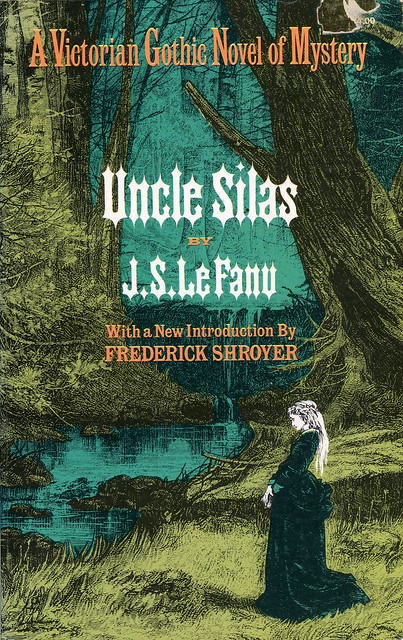
Uncle Silas by J. Sheridan Le Fanu

I love Victorian novels, but I love creepy Victorian novels the most and Uncle Silas certainly falls within the category of creepy.  It is very difficult for me to write non-spoiler book posts when mysterious are the subject, so consider this your warning:  there are spoilers out the wazoo ahead.

Maud Ruthyn is a very naive and very wealthy young woman who lives with her eccentric, kind, and bordering reclusive father.  Her father is a follower of Emanuel Swedenborg (an odd Christian oculist and scientist) and has a reserved, yet odd affectation.  Maud learns early on about her shamed Uncle Silas; in his youth Uncle Silas was a gambler, made an unfortunate marriage, and has been disgraced by a suicide committed by one of his house guests years earlier.  When her father dies, Maud learns -- much to the horror of other family members -- that she is to live with her Uncle Silas until she comes of age and if she dies before the age of 21, Uncle Silas inherits her fortune.  The book is chock full of  mystery, greed, murder, an evil governess, dark rooms, laudanum, lies, and hints at the paranormal.  Oh, and someone dies by being beaten with blunt object.  I COULD NOT PUT THIS BOOK DOWN.  It certainly remind me of the perfect mix of The Woman in White by Wilkie Collins meets The Mysteries of Udolpho by Ann Radcliffe. 

Sorry this review is so short -- I really want to be reading right now and not hammering away at the keyboard. Ha!

This book is #3 on my Classics Club list.

~~~~~~~~~~~~~~~~~~~~~~~~~~~~~~~~~~~~~~~~~~~~~~
#2 -- The Collected Stories of Elizabeth Bowen
#1-- The Tenant of Wildfell Hall by Anne Bronte

Sunday, March 18, 2012

The Sunday Salon: Classics Club

Okay, I've tried very hard to not sign-up for any new challenges until May and when I have a few completed (which reminds me I need to see where I'm at with my challenges).  BUT this isn't a year long challenge; this is a  five year challenge to read 50+ classics.  Of course we have the her bookishness Jillian to thank for this inspiring idea and pulling it all together.  I've picked 100 books to complete in the next five years (01 March 2012 - 01 March 2017).  You may notice that there are more than 100 books (technically) listed.  All of the novels composing The Forsyte Saga (9) and Kristen Lavransdatter (3) are not individually listed.  This will give me some wiggle room in case there are books I don't care to finish.  I have "shorter works" on my list, but I've chosen to read the entire short story collection to make it count.  I do have one play, Richard III, that is the shortest work on the list. 

I also set a few rules for myself:  1) all the books had to be published prior to 1950 and 2) I can reread, but only if I've read the book once or it has been over 5 years since I read the book).  So, alas, I cannot reread Jane Eyre and Wuthering Heights over over over and over again. But the good news is that I will hopefully increase my list of classics I adore.

On to the list!  Turquoise books are rereads and Greens are Viragos!
  1. The Tenant of Wildfell Hall by Anne Bronte (completed 04/17/12)
  2. The Leavenworth Case by Anna Katherine Green
  3. The Dead Secret by Wilkie Collins
  4. This Side of Paradise by F. Scott Fitzgerald
  5. Uncle Silas by Sheridan Le Fanu (completed 07/29/12)
  6. The Warden by Anthony Trollope
  7. Barchester Towers by Anthony Trollope
  8. Doctor Thorne by  Anthony Trollope
  9. Framley Parsonage by Anthony Trollope
  10. Small House at Allington by  Anthony Trollope
  11. Last Chronicle of Barset by  Anthony Trollope
  12. Far from the Madding Crowd by Thomas Hardy
  13. Kristen Lavransdatter (all three books) by Sigrid Undset
  14. Hunger by Knut Hamsen
  15. No Name by Wilkie Collins
  16. Memoirs of Sherlock Holmes by Sir Arthur Conan Doyle
  17. The Last September by Elizabeth Bowen
  18. Gothic Tales by Elizabeth Gaskell
  19. Orlando by Virginia Woolf
  20. Adam's Breed by Radclyffe Hall
  21. The Painted Veil by W. Somerset Maugham
  22. The Collected Stories of Elizabeth Bowen (completed 07/01/12)
  23. Howard's End by E. M. Forster 
  24. The Golden Apples by Eudora Welty
  25. The Blue Fairy Book by Andrew Lang
  26. Pickwick Papers by Charles Dickens 
  27. Oliver Twist by Charles Dickens 
  28. Nicholas Nickleby by Charles Dickens 
  29. Old Curiosity Shop by Charles Dickens 
  30. Barnaby Rudge by Charles Dickens 
  31. Martin Chuzzlewit by Charles Dickens 
  32. Dombey and Son by Charles Dickens 
  33. David Copperfield by Charles Dickens 
  34. Bleak House by Charles Dickens 
  35. Hard Times by Charles Dickens 
  36. Little Dorrit by Charles Dickens 
  37. A Tale of Two Cities by Charles Dickens 
  38. Great Expectations by Charles Dickens 
  39. Our Mutual Friend by Charles Dickens 
  40. Mystery of Edwin Drood by Charles Dickens 
  41. The Monk by Matthew Lewis
  42. Frankenstein by Mary Shelley
  43. Richard III by William Shakespeare
  44. The Woman in White by Wilkie Collins
  45. Middlemarch by George Eliot
  46. Jude the Obscure by Thomas Hardy
  47. Portrait of a Lady by Henry James
  48. Vanity Fair by William Makepeace Thackery
  49. The Invisible Man by H.G. Wells
  50. The Custom of the Country by Edith Wharton
  51. The Heat of the Day by Elizabeth Bowen
  52. Sister Carrie by Theodore Dreiser
  53. The Forsyte Saga (all 9 books plus the "interludes")
  54. The Portrait of the Artist as a Young Man by James Joyce
  55. Mrs. Dalloway by Virginia Woolf
  56. The Way We Live Now by Anthony Trollope
  57. Diana of the Crossways by George Meredith
  58. No Signposts in the Sea by Vita Sackville-West
  59. The Friendly Young Ladies by Mary Renault
  60. Hunt the Slipper by Violet Trefusis
  61. Sense and Sensibility by Jane Austen
  62. The Italian by Ann Radcliffe
  63. Lorna Doone by Richard Blackmore
  64. Daniel Deronda by George Eliot
  65. Sentimental Education by Gustave Flaubert
  66. Tess of the D'Urbervilles by Thomas Hardy
  67. The Wings of the Dove by Henry James
  68. He Knew He Was Right by Anthony Trollope
  69. East Lynne by Ellen Wood
  70. The House in Paris by Elizabeth Bowen
  71. The Professor by Charlotte Bronte
  72. The Oxford Book of Victorian Ghost Stories
  73. The Rising Tide by Molly Keane
  74. Without my Cloak by Kate O'Brien
  75. Harriet Hume by Rebecca West
  76. Persuasion by Jane Austen
  77. Melmoth the Wanderer by Charles Maturin
  78. Trilby by George Du Maurier
  79. Madame Bovary by Gustave Flaubert
  80. The House of the Seven Gables by Nathaniel Hawthorne
  81. Passage to India by E M Forster
  82. For Whom the Bell Tolls by Ernest Hemingway
  83. The Thing on the Doorstep and Other Weird Tales by H P Lovecraft
  84. The Call of Cthlulu and Other Weird Tales by H P Lovecraft
  85. The Thinking Reed by Rebecca West
  86. Wives and Daughters by Elizabeth Gaskell
  87. The Three Sisters by May Sinclair
  88. Shirley by Charlotte Bronte
  89. Cranford by Elizabeth Gaskell
  90. War and Peace by Leo Tolstory
  91. War of the Worlds by H.G. Wells
  92. A House and Its Head by Ivy Compton-Burnett
  93. The Collected Shorter Fiction of Virginia Woolf
  94. Summer will Show by Sylvia Townsend Warner
  95. The Judge by Rebecca West
  96. The Return of the Native by Thomas Hardy (completed 12/31/12)
  97. Anna Karenina by Leo Tolstoy
  98. All Passion Spent by Vita Sackville West
  99. A Handful of Dust by Evelyn Waugh
  100. Brideshead Revisited by Evelyn Waugh
I've thought long and hard about my list.  Over three quarters of the novels are books I own.  I'm also incorporating my desire to read all of Dickens's novels in order, complete a Trollope series, and read a stack of Viragos.  My approach is that challenge success is based on making challenges work together.

Okay -- mini-rewards.  For every 5 books off of this list I read I will purchase one classic novel NOT ON THIS LIST in a nice copy.  By nice copy I mean that it isn't a ratty paperback in a thrift store bin -- it could be a vintage something in good condition, a Penguin clothbound, a newish edition with a lovely introduction.  See, I'm already prepping for 2017 onward!  At the end of my 100 books read I will have 20 new-to-me classic novels that are lovely, pristine, and will beautify my shelves, my mind, and my imagination.

I hope you'll join us in the Classics Club!  I think this will be an amazing experience.

The Sunday Salon.com